
Salem Virginia Property Records
Salem property records are filed with the Salem Circuit Court Clerk at 2 East Calhoun Street. Salem is an independent Virginia city with its own circuit court, separate from Roanoke County. The clerk records deeds, deeds of trust, plats, liens, and all other land instruments for real estate within city limits. The Commissioner of Revenue handles assessment and tax data available online. Records are public. You can search online through the Virginia courts land records system, visit the clerk in person, or send a written request by mail for copies of any recorded documents you need.
Salem Property Records
Salem Circuit Court Clerk and Land Records
The Salem Circuit Court Clerk serves as the keeper of all land records for the City of Salem. This is a constitutional officer who records deeds, deeds of trust, liens, judgments, and plats. Each instrument filed creates a permanent public record tied to a specific parcel. Under Title 55.1 of the Virginia Code, recordation gives legal notice to the world of a property interest.
The clerk's office is located at 2 East Calhoun Street, Salem, VA 24153. Phone: (540) 375-3067. Clerk of Court: Hon. Chance Crawford. Office hours run 8:30 a.m. to 4:30 p.m., Monday through Friday. Staff can help you search by grantor name, grantee name, instrument number, or book and page. Walk-in searches are free to the public.
Salem is an independent city in the 23rd Judicial Circuit. Its records are kept separate from Roanoke County even though both localities share the same courthouse building. If you are searching deeds for property located within the city limits of Salem, you must search the Salem records specifically. County records will not include city parcels. Copies of recorded documents cost 50 cents per page, with an additional $2 fee for a certified copy.
Virginia's statewide Secure Remote Access system at vacourts.gov lets you search land record indexes online. Free index-only access may be available for Salem depending on whether the clerk has enabled that option. Full image access requires a subscription authorized through the Clerk's office. For older instruments or plats, an in-person visit may be the most reliable approach.
Salem Real Estate Online Database and Assessments
The City of Salem runs an online real estate database so the public can look up parcel data, assessed values, ownership history, and recent sales. The system is hosted through actDataScout and is sponsored by the Salem MNC assessor's office. You can reach it at salemva.gov/589/Real-Estate.
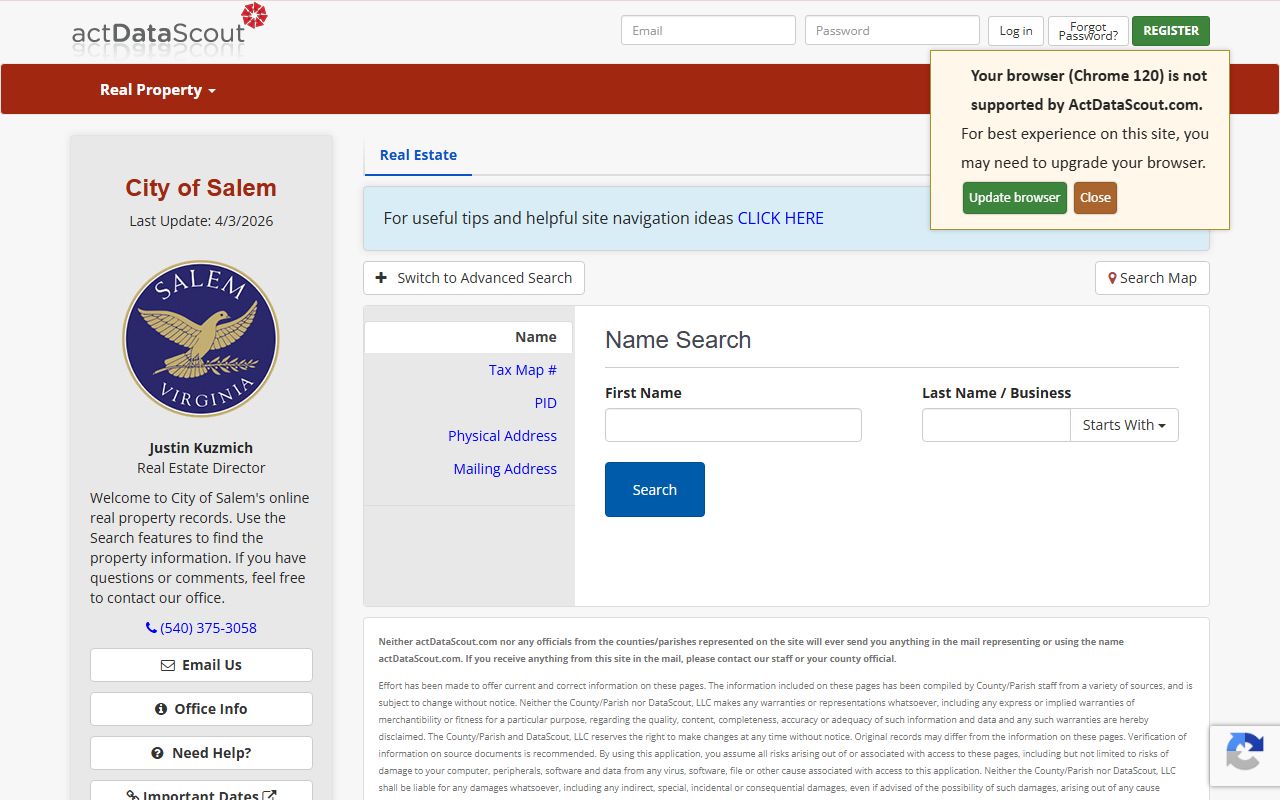
You can search by owner name, address, or parcel number. Results show the property's assessed land value, improvement value, and total assessment. The database also includes sales history and basic parcel information such as lot size and zoning class. The data is updated on a regular basis, though the city notes that original records may differ from what appears online and that verification against source documents is recommended.
Assessment notices for real estate are issued annually. If you think your assessment is not fair, you have the right to appeal. The Commissioner of Revenue's office handles inquiries about assessments on extension 2. The Treasurer's office handles payment questions on extension 1.
Commissioner of Revenue and Tax Programs
The Commissioner of the Revenue is the office responsible for implementing the tax policy decisions of Salem City Council. The office sits between local government, the Treasurer's Office, and Salem's citizens. It handles a wide range of tax functions beyond just real estate.
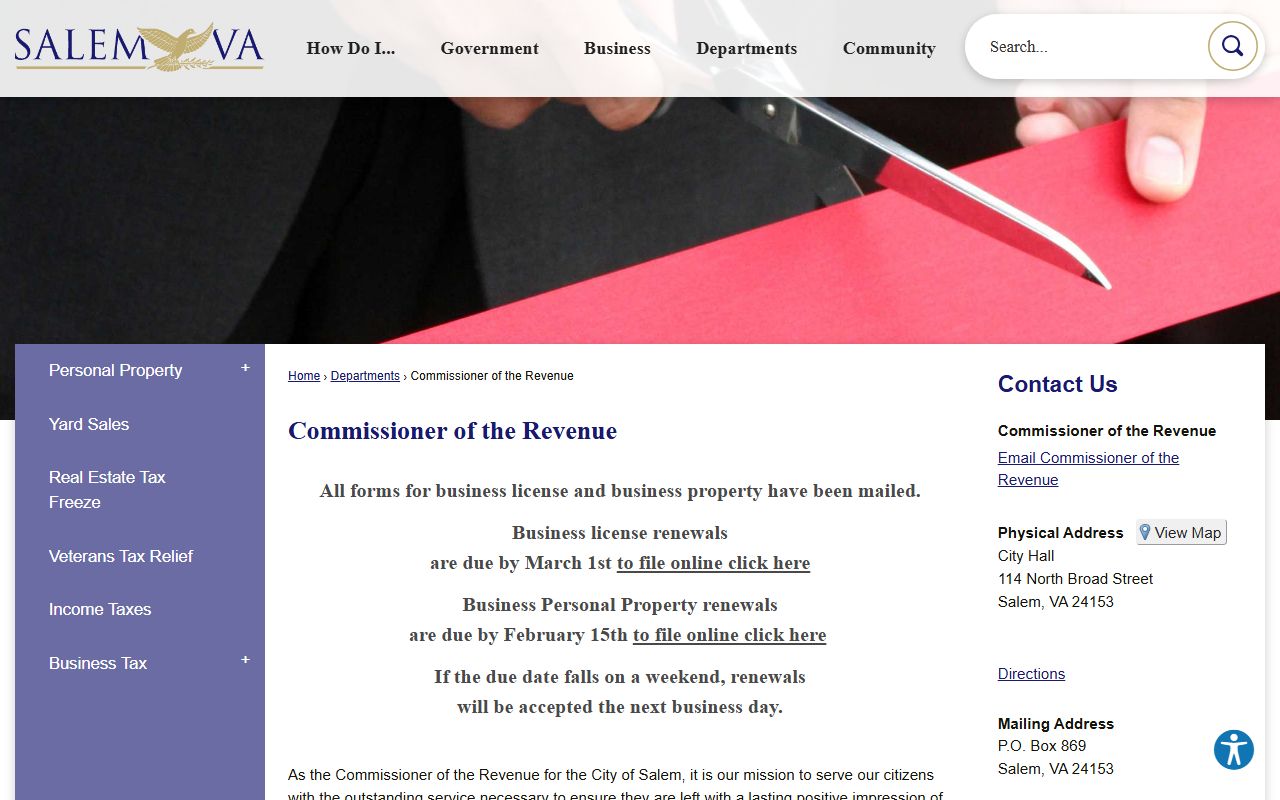
Key programs run by this office include a real estate tax freeze for elderly and disabled homeowners and a tax exemption for qualifying veterans. To reach the Commissioner's office, call (540) 375-3019. The physical address is City Hall, 114 North Broad Street, Salem, VA 24153. Office hours are Monday through Friday, 8 a.m. to 5 p.m.
Business license renewals are due by March 1 each year. Business personal property renewals are due by February 15. These deadlines do not affect residential real estate records, but knowing which office handles which function helps you get to the right place faster. Real estate assessment questions go to extension 2. Vehicle and personal property questions go to the Commissioner directly.
Salem GIS and Tax Maps
The City of Salem GIS Division provides a public mapping application that lets you search by address, street name, or tax ID number. The GIS portal is part of the Community Development Department and can be found at salemva.gov/205/Geographic-Information-Systems-GIS. It links to the real estate database and lets you view parcel boundaries, flood zones, and zoning layers on a single map.
The GIS Open Data Portal is Salem's platform for exploring and downloading GIS data. It includes several web applications: the Salem GIS Public Site for general parcel information, the Subdivision Plat and Survey Map with links to available plats by tax parcel, a Zoning Map for each parcel, and a Flood Zone Map for researching flood information on city properties. These tools are web and mobile friendly.
Salem also publishes downloadable tax maps in PDF format at salemva.gov/184/Tax-Maps. Individual maps numbered 001 through 318 are available, along with a Tax Map Index for download. The city notes that tax maps identify parcels but are not to be used for legal purposes or as a substitute for a formal land survey. For legal descriptions, rely on the recorded deed.
GIS data is updated on a regular basis, typically on Friday mornings between 8 a.m. and 10 a.m. The site may not be available during those update windows. Contact the GIS division at (540) 375-3032. Staff include Jason Simpson, GIS Manager, and Ryan O. Jarratt, GIS Analyst, located at 21 South Bruffey Street, Salem, VA 24153.
How to Request Records in Salem
You have several ways to get property records in Salem. For recorded land instruments such as deeds, go directly to the Circuit Court Clerk's office at 2 East Calhoun Street. You can walk in, call ahead at (540) 375-3067, or send a written request with payment. Copies cost 50 cents per page.
For tax and assessment records, use the online real estate database at salemva.gov or contact the Commissioner of Revenue at City Hall. For GIS data and parcel maps, use the online portal or contact the GIS division directly. Each office handles a different part of the property records system, so knowing which type of record you need points you to the right place.
Virginia's Freedom of Information Act applies to public records held by all city offices. Under § 55.1-600 and related statutes, recorded land records are public by default. The city must respond to FOIA requests within five working days. Costs are limited to actual duplication and search expenses. If a request is complex or involves redactions, the city may charge for staff time spent on those tasks.
If you want a name-removal request from the online real estate database, Salem provides a Name Removal Request Form available through the GIS and real estate pages. Submit the completed form to have your name taken off city real estate websites. This applies to the online database only and does not affect the permanent court records, which are public under state law.
Virginia Property Law and Salem Recordation
All property conveyances in Salem are governed by Title 55.1 of the Code of Virginia. This title covers deeds, trusts, mortgages, liens, and the rules for how instruments must be drafted and recorded. A deed is not legally effective against third parties until it is recorded with the Circuit Court Clerk. Recording fees are set by state law and apply uniformly across Virginia.
When a deed is filed, it must be accompanied by a Virginia Land Record Cover Sheet. This cover sheet gives the clerk the information needed to properly index the instrument. The deed must identify the grantor, grantee, legal description, and consideration. If any required information is missing, the clerk may reject the filing.
Deeds of trust are the most common form of mortgage in Virginia. They involve three parties: the borrower (grantor), the lender (beneficiary), and a trustee who holds nominal title as security. When a loan is paid off, the lender records a Certificate of Satisfaction to release the lien. You can find these release instruments in the same land records index as the original deed of trust.